
Why it works
Affirmations argue with your brain. You say "I am wealthy" and a quiet voice answers "no you're not," and that argument is the whole experience. A news article skips the argument. When a neutral third party reports your life as accomplished fact, with a dateline, background, and quotes, your nervous system files it the way it files any other reporting: as something that already happened. The believability is the mechanism. Which means the entire craft is in making it believable: real names, real towns, real numbers, restrained language, no hype.
The protocol
- The sit-down. Set aside deep time. The full version is four hours, phone in another room. Write what you want your life to look like in the third person, present tense. Not "I will have a workshop" but "[Name] walks into the workshop." Don't list goals; write scenes. Use the ten prompts below.
- Build the dossier. Pull the true facts of your past: hometown, family, the schooling, the jobs, the leap, the numbers you've actually written in notebooks. The profile needs verifiable history to make the future feel reported. If you journal, you've already written most of this.
- Generate the script. Feed the dossier and your scenes into an AI with the generation prompt below. Ask for roughly 150 words per minute of audio; 800 words is a strong five-minute first cut.
- Give it a voice. ElevenLabs, text to speech. Do not clone your own voice. The illusion is a stranger reporting on you, with no reason to flatter you. Pick a calm documentary narrator and use the settings below.
- Listen every night. Export the MP3 to your phone. Play it in bed, low volume. Take three slow breaths before you press play. Let the body settle first, then let the story land. Repetition is the practice; don't re-cut it for at least 30 days.
The sit-down
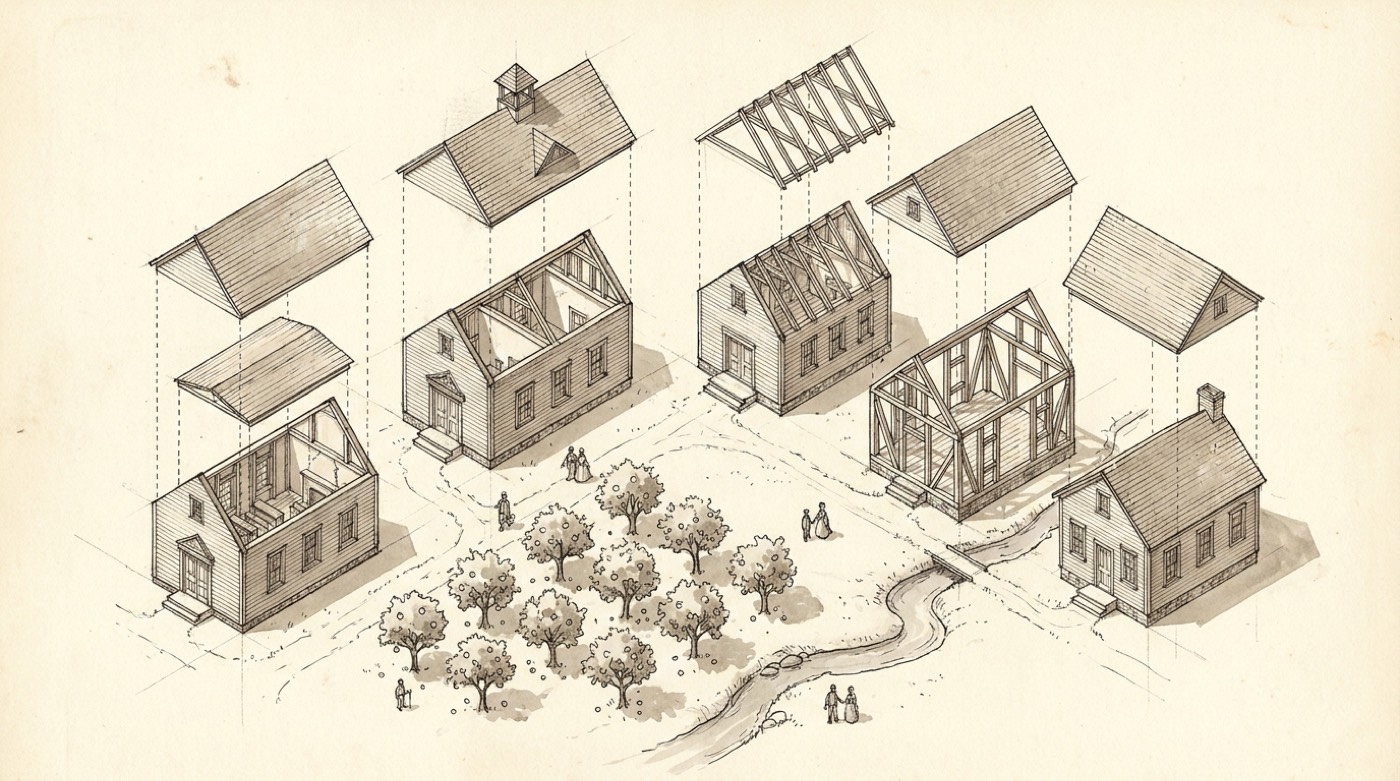
Ten prompts, in order. Third person, present tense, no editing. Scenes, not goals. In every scene, note what it feels like in the body. The feeling is the active ingredient.
- 6:00 AM. They wake up. Where? What does the light do? First sound? Write 20 minutes without stopping.
- The walk. They step outside. Walk the whole property. Name every structure, everything growing, everything being built.
- The work block. What are they actually doing at 10 AM on a Tuesday? Who's on the call? What do they no longer do, because someone else does?
- The hands. Afternoon, away from screens. What's on the workbench? What's the material? Who is it for?
- The table. Dinner. Who's there. What's on it. What's the conversation.
- The money. Write the balances. Write the monthly number. A big opportunity shows up; what happens in the first sixty seconds?
- The people they're building for. What do they call them? What did they do today? What are they teaching without saying it out loud?
- The hard part. What did they give up? What do they still fight? Write it honestly. The script is stronger with a shadow in it.
- The return. They go back to where they came from. What's changed? Who's standing there with them?
- 9:00 PM. They write one line in a journal. What is it?
The generation prompt
Paste this into your AI along with your dossier and your sit-down scenes. Fill the brackets.
Voice settings
ElevenLabs, Text to Speech. Pick a mature documentary narrator from the voice library: warm, neutral, unhurried. Test three; keep the one that makes your chest drop.
| Setting | Value | Why |
|---|---|---|
| Model | Multilingual v2 | Most stable for long, even reads. Flash is built for speed, not warmth. |
| Stability | 50 to 60 | This should sound read off a page, not performed. |
| Similarity | 75 | Standard. |
| Style | 0 to 15 | Flat delivery is more believable than dramatic delivery. |
| Speed | 0.95 | Slightly under normal. Give it room. |
Make it more real
- Layer a quiet ambience bed under the voice (birds, wind, distant water) around minus 30 dB. News pieces have room tone; silence sounds synthetic.
- One restrained music sting at the open, returning at the close. Not throughout.
- Run the final mix through a free enhancer (Adobe Podcast Enhance) to glue voice and ambience into one recording.
Write the quotes last
This is where a script most often dies, and it took building several to learn it. An AI will hand you quotes that sound like the sort of thing you might say. You will hear them read aloud and something will go flat, because a sentence you never said is the one place the illusion breaks. Your own ear catches it even when you cannot explain why.
So treat the generated quotes as placeholders. Go find real ones. Things you have actually said to a partner, a sibling, a client. A line you wrote in a journal years ago. The sentence you repeat when you explain your work at a dinner table. Then paste them in over the invented ones, unedited, including the parts that are slightly awkward. Awkward is the sound of true.
Build a set, not a tape
One recording is the start. What actually holds is a small set of tracks for different states, because the research points two directions at once and a single tape cannot serve both.
Third-person reported narrative is what slips past the part of you that argues. First-person felt rehearsal is what puts the state in your body. Those are different mechanisms. So stop asking one recording to do both jobs and make two.
| Track | When | Form |
|---|---|---|
| The profile | Night, in bed | Third person. A reporter describes your life as accomplished fact. |
| The morning | Feet on the floor | First person. Breath, then gratitude, then one scene felt from inside. |
| Before deep work | Start of a work block | Second person. Narrow to one thing, then name who it is for. |
| The loop closer | When the mind is loud | Every open project named, each one released for the night. |
| The hard day | When you almost skip it | Your evidence read back to you. Wins, not plans. |
Make the profile first and live with it. Add the others only when you notice a state the set does not cover. The fifth one matters more than it sounds: in a thirty night practice, the nights that decide the outcome are the ones you almost skipped.
Count the nights
Repetition is the mechanism, which means consistency is the only input you control. Track it somewhere you will see it. A streak, a row of thirty boxes, a mark on a calendar, whatever you will actually look at.
Two reasons this matters more than it seems. First, familiarity does real work here, and only accumulation produces it. Second, on the night you do not feel like it, a visible streak is a more honest argument than motivation is.
What the research actually says
Worth being precise, because this territory is full of overclaiming.
Well supported. Vivid, realistic future selves change present behavior; the effect depends on the future self feeling similar and plausible, not idealized, which is the reason to use your real number rather than a bigger one. Third-person self-reference measurably lowers emotional reactivity, so the reporting frame is doing real work. Absorbing narrative reduces counterarguing. Specific sensory detail beats abstraction. Repetition raises felt truth on its own.
Reasonable, not proven. Listening before sleep. Sleep consolidates material you already encoded, so the timing is defensible, but no study tests this exact practice. Sleep learning of new content is not a thing.
Commonly misattributed. The third-person device does not come from the visualization coaches, whose material is first person and embodied throughout. It comes from research on distanced self-talk. Worth knowing if you teach this to anyone.
The honest weak point. Passive listening is the softest part of this protocol, since the embodiment side of the literature says physiology has to change for belief to follow. Mitigate it: breathe before you press play, listen from inside rather than watching from outside, and let a line land instead of rushing to the next.